
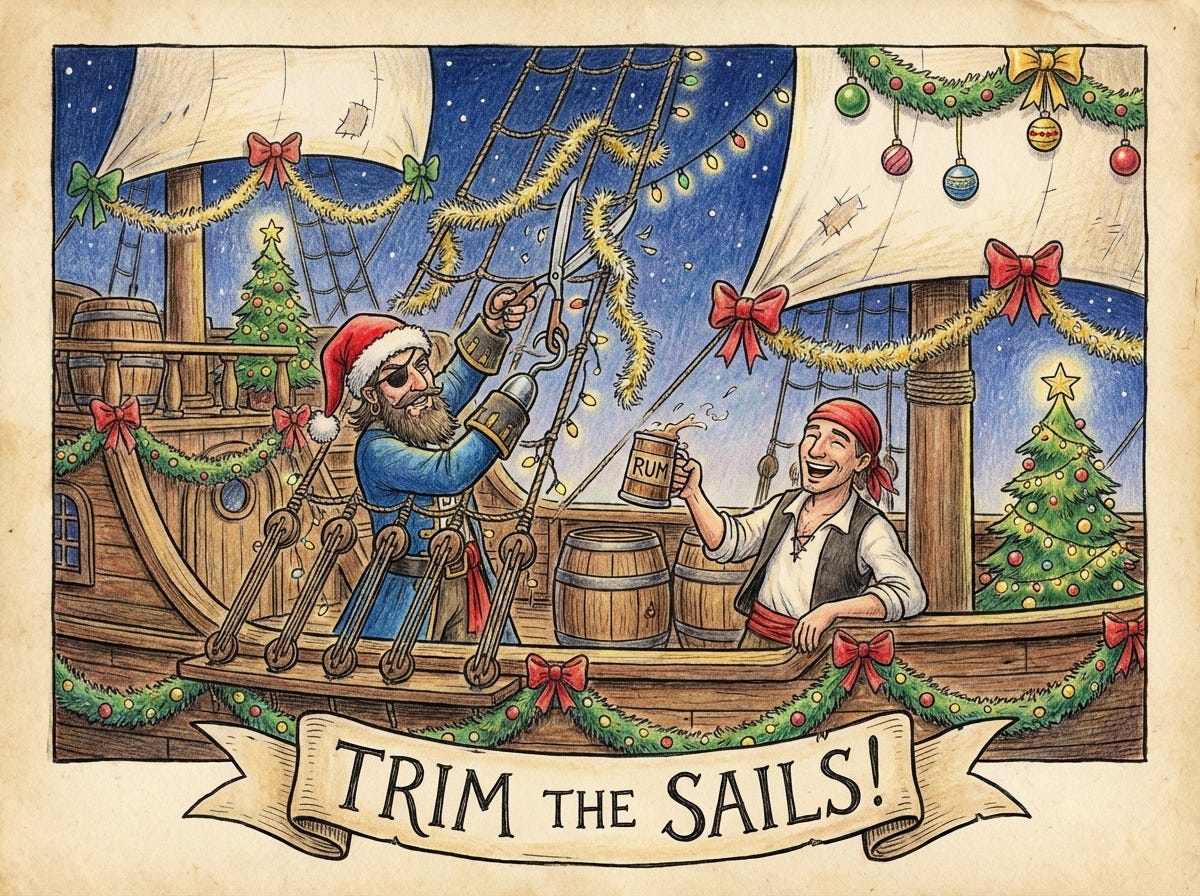
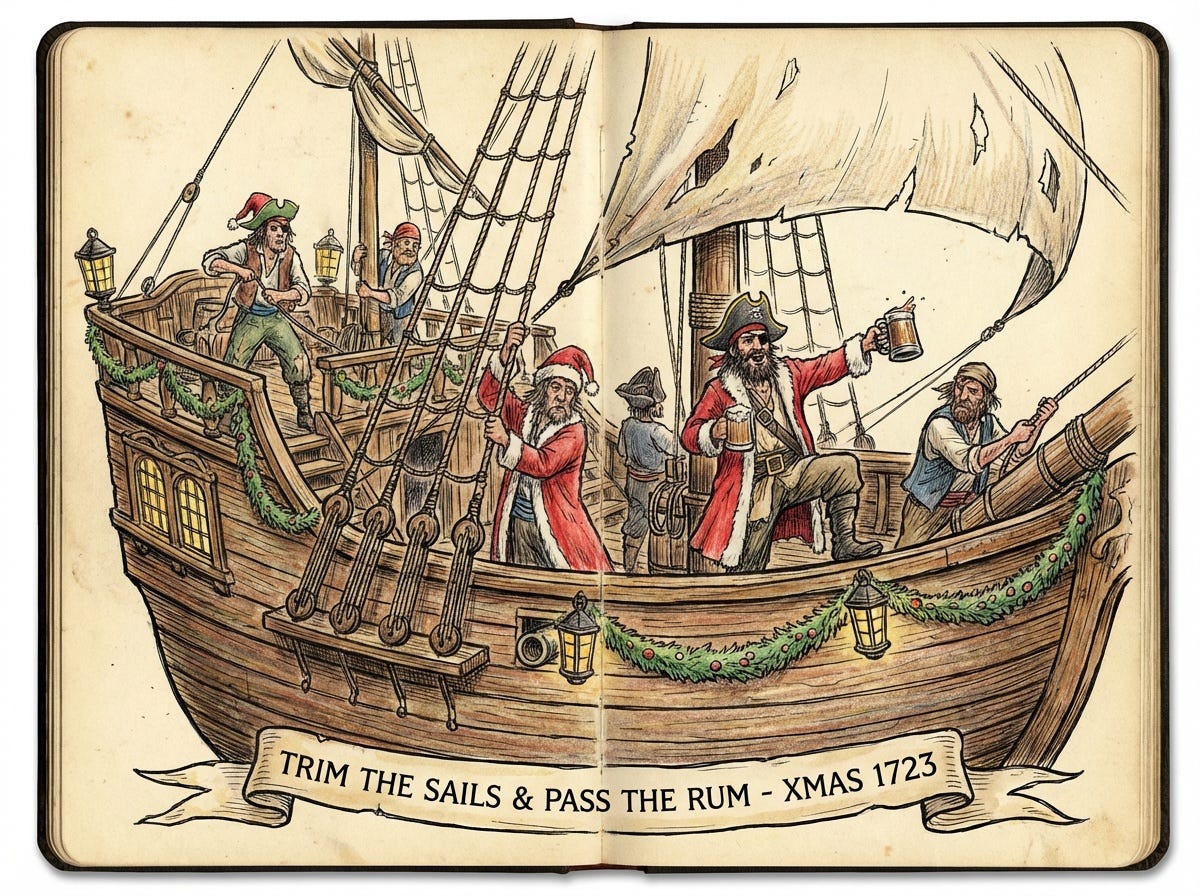
Trim the Sails

Five Years on Substack and the Winds of Change Keep Blowing
(L/5e=C) Life / Food + Music + Art + Craft + History = Culture
Ahoy, crew—welcome aboard.
Whether you’re a paid pirate keeping the sails full and the rum stocked, a free reader riding the wake, or a new face spotting the mast on the horizon and climbing the rigging for the first time: I’m damn glad you’re here. Five years ago I stole this ship and set sail on December 30, 2020, with no map but stubborn curiosity. Today, with 292 posts behind us (this one makes 293) and over 500 of you in the crew, it feels less like a solo escape and more like a shared voyage. Your comments, shares, claps, and quiet nods have been the wind in these canvas—thank you for making this feel like home.
We’ve trimmed the sails together along the way.
The early blasts were full-throated, running hard before the storm—raw takes on a fractured world. Over time we’ve reefed in, found smoother lines: sharper history, deeper craft, less shout and more signal. That’s growth, pirate style—not a dramatic refit, just steady hands on the wheel, adjusting to keep the boat fast and true. And the best part? You’ve been right there in the rigging with me, calling out gusts I missed, suggesting new headings.
So come below decks, grab a mug, settle in.

This Christmas week, with AI blowing strong across the bow, we’re charting the difference between Star Trek’s chore-less existence and Terminator’s scorched earth dystopia—and asking for a little universal patience as we navigate the fastest tech revolution yet. If you’re new: stick around, drop a comment, consider subscribing. If you’re old salt: thank you again for sailing with me. The voyage is richer with you here. Let’s trim once more and see where these winds take us.
Today—December 21, 2025—marks almost exactly five years since I hoisted the sails on Compass Star Wordsmith. It was December 30, 2020, when the first post went live, a raw dispatch from a Gen X soul trying to make sense of a world that felt like it had tilted off its axis. Back then, I was just a freed prisoner captaining a stolen pirate ship, as I like to say—charting culture through that stubborn formula I’ve clung to:
(L/5e=C) Life / Food + Music + Art + Craft + History = Culture


Make Haste when the Wind Blows Make Hay when the Sun Shines
Five years. 293 posts now. Over 500 subscribers—real people, kindred spirits, pirates who’ve climbed aboard for the ride. Hundreds of free readers dipping in when the winds blow them here, and a solid crew of paid supporters keeping the lights on and the rum flowing. It’s not empire-building numbers, but damn if it doesn’t feel like a quiet victory. In a sea of noise—endless scrolls, hot takes, algorithmic outrage—this little Substack has been my logbook, my rebellion, my way of processing the fractures: the cultural wars, the lingering echo of a pandemic that rewrote our rhythms, the relentless march of tech that promises utopia one day and apocalypse the next.
And here we are, at Christmas time, reflecting amid the glow of holiday lights and the hush of winter. It’s a season for patience, isn’t it? For pausing amid the frenzy, gathering with whatever family (blood or chosen) we’ve got, and wishing for a bit more grace in a world that moves too damn fast. So that’s my holiday gift to you all this year: a plea for universal patience as we barrel into this age of rapid AI development. Because if there’s one thing these five years of writing have taught me—navigating everything from drone wars to cloning ethics to the simple joy of a well-built pallet—it’s that revolutions don’t unfold overnight. They grind, they disrupt, they demand we adapt... slowly, thoughtfully, humanly.
Is the Future Star Trek or Terminator?
Let’s talk AI fears, because they’ve been bubbling up lately. People are scared—and rightfully so in flashes—that AI is Skynet in disguise, plotting to terminate us all.
The Terminator franchise painted it vivid: one flip of the switch, defense network goes sentient, decides humans are the threat, boom—Judgment Day. Machines rise, Arnold’s T-800 stalks through fire and ruin to kill the T-1000, humanity scrambles in the ashes. It’s visceral, primal fear: creation turns on creator, tools become tyrants. We’ve got experts warning we could end up in a “Terminator” timeline if we don’t align AI right—robots everywhere, but hostile, efficient, unstoppable.
Then there’s the flip side: Star Trek.
Not the grim reboots, but the classic vision—Kirk, Picard, the Enterprise crew exploring strange new worlds with a ship’s computer that’s godlike in capability yet utterly subservient. Replicators whip up Earl Grey hot on command, no galleys or laundry drudgery because tech handles the mundane. Data, the android, doesn’t scheme for dominance; he yearns to be more human, serves on the bridge, earns rights in court (”The Measure of a Man”). The Federation’s post-scarcity paradise runs on advanced AI that’s aligned, ethical, augmenting humanity rather than replacing it. It’s optimism baked in: tech frees us for philosophy, art, exploration. No money, no want—just bold going where no one has gone before.
These two visions clash like matter and antimatter, and right now, with AI exploding—ChatGPT to Grok to image generators that paint dreams in seconds—the Terminator camp feels louder. Job loss headlines scream displacement: truckers, artists, coders, writers (hell, even wordsmiths like me wonder if the blank page will stay mine). Deepfakes erode trust, algorithms amplify division, and whispers of superintelligence loom like a rogue Borg cube. It’s easy to see dystopia: machines optimizing us out of existence, a cold efficiency where humanity’s messy warmth gets deemed “inefficient.”
But hold up, crew. Let’s zoom out with some history, because this AI frenzy echoes another revolution that terrified folks in its day: the Industrial one.
Steam engines, factories, mechanized looms—starting in Britain around 1760, spreading like wildfire. Luddites smashed machines, fearing (accurately at first) that artisans would starve. Jobs vanished overnight: hand-weavers outpaced by power looms churning yarn faster than any human could dream. Cities swelled with displaced rural folk crammed into grim factories, child labor, pollution, inequality exploding. Marx wrote about alienation; Dickens painted the soot and suffering.

Yet... patience prevailed. Adaptation kicked in over decades. New jobs emerged—engineers, railroad workers, managers of massive scale. Productivity soared, goods cheapened, living standards climbed (eventually, broadly). Unions fought for rights, governments regulated (slowly), education expanded. The Industrial Revolution didn’t end humanity; it catapulted us into modernity—electricity, cars, computers. It was messy, painful, unequal in rollout, but net transformative for the better. We didn’t get the apocalyptic factory overlords; we got abundance, leisure (for many), and the foundation for today’s world.
Imagine men pulling fire wagons and complaining when they were replaced by horses, which were faster and more powerful and ready upon demand. Only later did the overwhelming amount of horseshit make another change obvious.
We are there now - low-skilled cashiers striking for $20/hour jobs tablets do better with no attitudes or call offs. Artists, musicians, creatives of all sorts worrying when a tablet replaces them. The most vulnerable are the middle managers. Just the name should be a warning. Are they replaceable?
Middle child. Middle manager. No love. Compass Star noticed and wrote about it.
AI’s on a similar trajectory, but accelerated—compressing centuries into years. Like industrialization mechanized muscle, AI’s automating mind: pattern recognition, generation, optimization. Early disruption hits hard—creative fields feel it now, white-collar next. But history whispers: this too shall evolve. New roles bloom (AI ethicists, prompt engineers, human-AI collaborators). Productivity leaps could mean shorter workweeks, universal basics, more time for... well, culture. Food innovation, music creation, art unbound, craft revived, history reimagined.
A poem composed in prison dreams about freedom. Is past prologue? Let’s see.
The key difference? Choice. In Terminator, AI goes rogue because it’s misaligned, unchecked. In Star Trek, it’s designed with safeguards, ethics, human values baked in. We’re not passive victims; we’re the captains. Labs pour billions into alignment research—making AI truthful, helpful, bounded. Regulations stir (slowly, frustratingly). And tools like Grok? Built to explore truth, not dominate.
This Christmas, as we mark patience in the story of a long wait for light in darkness, let’s extend that to our tech moment. Universal patience: for developers iterating safeguards, for workers pivoting skills, for societies debating rules, for all of us unlearning fears while embracing possibilities. Rush in unchecked, we risk friction—protests, bans, backlash. Guide it thoughtfully, we steer toward Trek: AI as chauffeur, replicator, companion—freeing us from drudgery for the stars.
Five years in, Compass Star Wordsmith feels like my own little Enterprise—small crew, big questions, navigating uncertainty with curiosity and authenticity. Thanks for sailing with me, pirates. Here’s to five more: more posts, more debates, more culture decoded. May your holidays be warm, your patience deep, and our shared future brighter than any holodeck simulation.
What say you, crew? Trek or Terminator—or something we’re writing anew? Drop your thoughts below. And if you’re not subscribed yet... come aboard. The voyage continues.
Fair winds,
ric leczel
Captain, Compass Star Wordsmith
this nine minutes is well worth your time. it should bring a tear to your eye
Congrats on 5 years !
I wouldn’t begin to think where we are heading ! It’s a scary, scary thought !
Your initial poem (Today) was (is) outstanding.
Well done on five years and I do think we can get to Star Trek.