
The World After
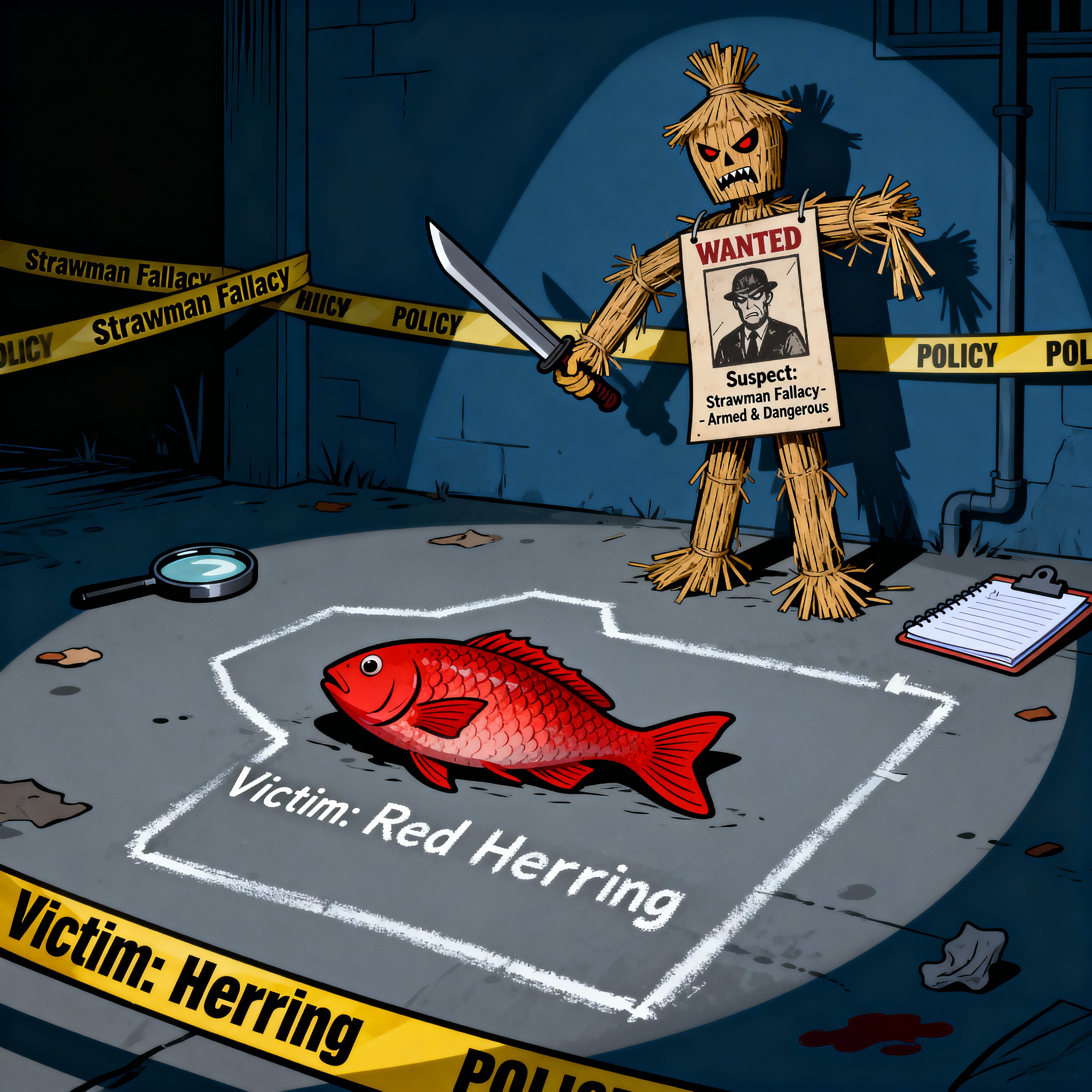
The last Red Herring on Earth was just murdered. The main suspect, Straw Man Fallacy, remains at large and is considered armed and dangerous. Lock your mind.

Some years ago I wrote a post titled “Can We Argue?” in which I posited the radical position that argument is ok. In fact, it’s healthier than not arguing. But what passes as modern argument is nothing more than rhetorical remissness.
Argument is a substitute for war some people say. Or as Sun Tzu argued “the supreme art of war is to subdue the enemy without fighting”, and he stated that a nation never benefits from prolonged warfare. I say argument is not as much a substitute as a prophylactic for violence. Which is basically agreeing with Tzu.
Can We Argue?

What is an argument? And why do we have them? Are they, or should they be, always antagonistic? Are they emotionally damaging? Are they to be avoided?
A female cop once told me on a bad night “arguments don’t always end in violence, but violence always starts with an argument.” Which makes sense if you think about it from her street corner: the arguments she responds to are better described as verbal confrontations, personal insults, or disrespectful behavior. I’ve never seen a cop referee an Oxford Debate, calling out illegal allegories.
So what is it about an argument that catalyzes passion, creates tension, or causes violence? One could argue (so intended!) the current national education report card provides massive clues as to why the rhetorical arts are all but extinct. Our kids are stupid and ignorant. Not all, but many. Not an insult, just observation.
Visual Social Media allows for ever greater numbers of innumerate and illiterate individuals to succeed in pop culture on a grander scale than ever before. Which is perfectly ok from a capitalistic point of view. I begrudge nobody a paycheck earned, no matter the profession. But absent a platform, where is their value?
Mind you, coders, lawyers, and analysts just got the Amazon AI Axe, so maybe ignorant and apathetic is a viable job option these days. It’s hard to live on code when you’re the of the grid. But again, no grid, no influence. What happens after?
My quarrel (again!), rather, comes from a different place. If we argue more with good faith, we fight less with bad. But the current atmosphere does not lend itself to nuance and discernment.
Culture’s shotgun wedding to politics a decade ago rippled out to now and beyond. The gold, the glitter, the gumption; a Love Child was birthed—half-influencer, half-ideologue, diapered in hashtags, raised on outrage, and now old enough to cancel nuance while torching every bridge it crosses.
Living in chaos sharpens several skills. Some of which are admirable traits: adaptability, industriousness, and resilience. Characteristics worthy of praise and useful in a civilized society to coexist with other like-minded individuals.
But what of manipulation, deceit, and subterfuge? The survival skills that chaotic childhoods demand rather than teach are sticks of dynamite waiting to be lit. Those very skills were instrumental when I lived in a 6x9 bathroom with another convict for 247 days, providing validation and proof of their worth in a fractured society. They were less useful in relationships, marriages, and careers I’ve lost.
Set loose on society, Gen-X ran amok with oversized expectations and undersized abilities in grown-up social settings. Seldom-supervised, never-minded, always-scolded, and forever-forgotten worked out well for awhile.
Mostly in our 20s and 30s in the 80s and 90s, when clubs, cocaine, and corporatism captured our delusions, we spent our youth strung out on hope and banking on change that never happened. When we sobered up, reality sucked.
The decades piled up and the temperment wore down. The cognitive dissonance Gen-Xrs subconsciously navigated became a pirates cove of comfort, calm, and control. No longer battling each other, our demons settled on external targets, easing the internal conflict and expanding the war to new and familiar territory.
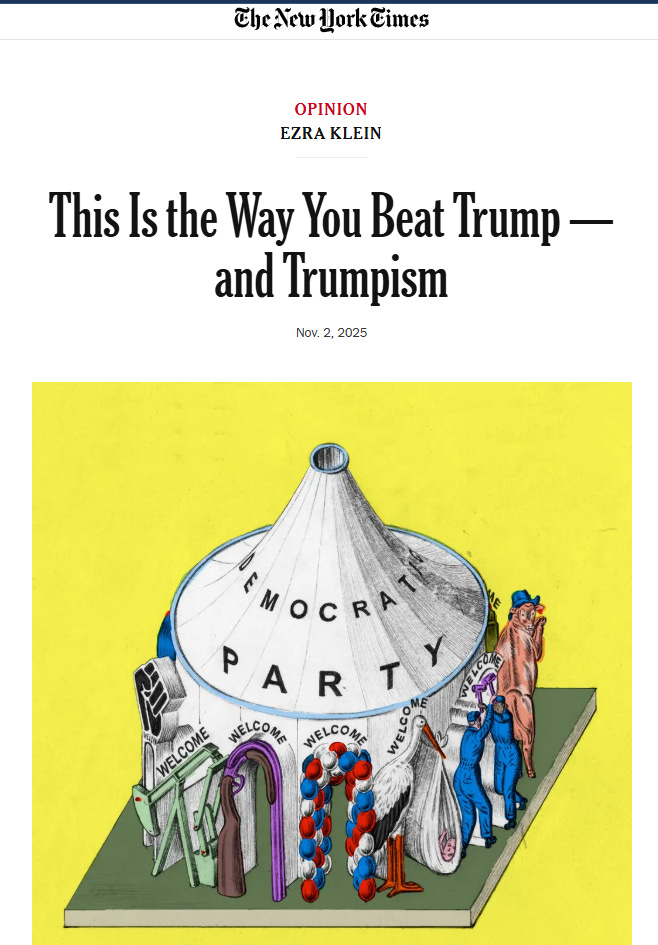
I found an interesting read here in all places the NYT, not because the dude knows what he’s talking about, but because the prescription he writes for the Dem party swirling the bowl is an exact copy the object of his scorn filled a decade ago when he cashed out the Bushes, Cheneys, and Romneys to enlarge the GOP.
The solution is simple he reasons: recapture - magically somehow - the millions of disgusted, disaffected, and disabused voters the Dem party shed in the era of The Bad Orange. Here’s the monumental problem they face
That echoes what I have heard from the kinds of voters Democrats lament losing. I feel as if I have the same conversation over and over again: Sometimes people tell me about issues where the Democratic Party departed from them. But they first describe a more fundamental feeling of alienation: The Democratic Party, they came to believe, does not like them.
Many of these people voted for Democrats until a few years ago. They didn’t feel their fundamental beliefs had changed. But they began to feel like “deplorables.” They began to feel unwanted.
His easy-as-pie recipe is precisely the fix Trump carried down the golden escalator a million years ago it seems now. Gen-Xrs like me cast their first vote for a president for Reagan, and for me personally, I remained a registered R until Perot pointed out the sucking sound coming from The Establishmentarians.
Switching from R to I became a badge of honor for many disillusioned Alex P. Keaton wannabees. The party, the system, the apparatus were all rigged, in the mind of Gen-X. Ross Perot, a billionaire outsider from Texas utilized the most potent social media at the time: Infomercials.
Perot produced the first political infomercials as a direct line of communication to the masses. This formula was emulated and perfected by guess who?
That chart above is illustrating the eye-popping national debt in 1992 - $4 Trillion. Small potatoes now, right? Perot was so right and so disdained. He led a mass exodus from the GOP by 20 and 30 somethings the party never recovered from until now. Ironically, a billionaire won the popular vote as a Republican.
The youth now in the MAGA world are existential threats to the Dem Party and can explain much of the current hysteria on their side. The Student Body is Red.
According to the NYT “opinion expert”, the Dem party experienced a similar mass defection from their ranks over the last dozen years. From the piece
But it went wrong. Democrats became more uncompromising on immigration and lost support among Hispanic voters. They moved left on guns and student loans and climate, and lost ground with young voters. They moved left on race and lost ground with Black voters. They moved left on education and lost ground with Asian American voters. They moved left on economics and lost ground with working-class voters. The only major group in which Democrats saw improvement across that whole 12-year period was college-educated white voters.
The party of people of color and marginalized groups grew only one demo in their ranks: college-educated white voters. Let that sink in. So basically, all the Dems need to gain power back and finally beat The Bad Orange is to increase their popularity with every single voter demographic, except for white college grads.

No problem, I guess. But when “fight back” is the argument, the oratorical skills of hope and change have hit the cliffs. How ‘bout ‘argue back?” Starting at fight leaves little room for the long-sought “conversation” so many Dems yearn to start.
The World After starts in about three years. What happens after that? When does the fight end and the argument begin? Enough is Enough.
The playlist for this post is specially fun. Check out the last song - Leo Sayers “One Man Band”. I had never heard it before but I had long been adverse to the disco kings craft. I stand before you a changed man. Sayer wrote songs for Roger Daltrey, including “Giving It All Away”. Both are in the playlist. Worth a listen.
Give it your best. That’s all we can ask.
Ric
Interesting take Ric. The fact I"m to old to master hashtags is likely a gift in disguise.
Let’s all learn how to argue in a healthy exchange of different ideas.