
Shots Fired. Again.
The Most Dangerous Job in the Republic. A single bullet bends the arc of history, the consequences lasting centuries. Happy 250 America! Hope you can keep it.

Nothing like shots fired to steady the compass and sharpen the focus. If these Sunday reflections help you navigate uncertain times with clearer eyes and a steadier hand, consider joining the voyage. Compass Star Wordsmith is a reader-supported publication. To receive new posts and support this work, become a free or paid subscriber. Your thoughts and company on this journey mean more than you know.

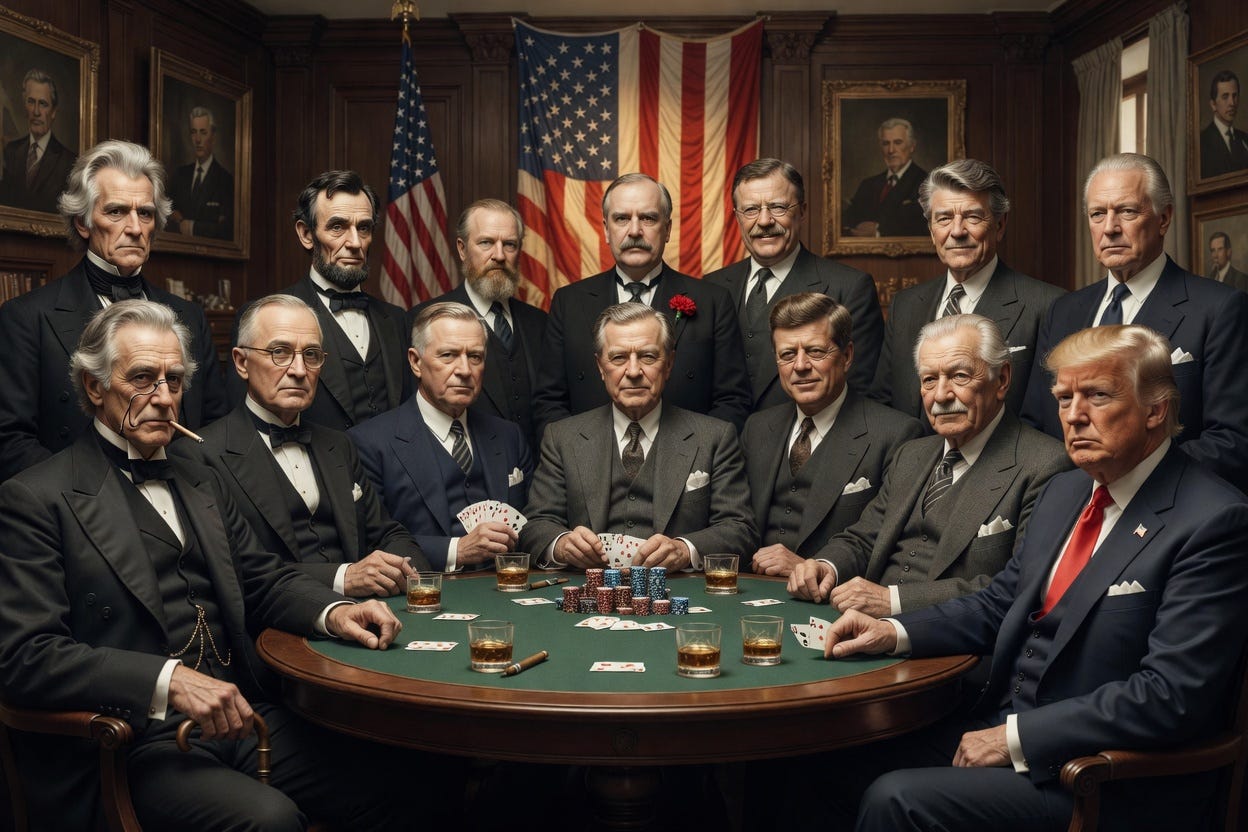
The phrase “shots fired” lands heavier every time it echoes through the news cycle
Another weekend, another report of gunfire aimed at the most visible seat of American power. The phrase “shots fired” lands heavier every time it echoes through the news cycle. It is not hyperbole; it is history repeating with grim familiarity.
Here is a clear-eyed layout of every U.S. presidential assassination and credible attempt since 1835 — successful killings, woundings, and the near-misses that still chill the blood. The record includes only documented incidents where a weapon was drawn or fired. Four presidents died. Three more were wounded but survived. Dozens of others came within a trigger-pull of the same fate.
The Four Who Fell
Abraham Lincoln, April 14, 1865
John Wilkes Booth, a Confederate sympathizer and actor, shot Lincoln in the head at Ford’s Theatre during the play Our American Cousin. The president lingered overnight and died the next morning. Booth’s act was part of a larger conspiracy to destabilize the Union at the end of the Civil War.
James A. Garfield, July 2, 1881
Charles Guiteau, a delusional office-seeker, shot Garfield twice in the back at a Washington, D.C. train station. Garfield survived for 79 agonizing days before dying of infection. His death led directly to civil-service reform.
William McKinley, September 6, 1901
Leon Czolgosz, an anarchist, fired two shots into McKinley’s abdomen at the Pan-American Exposition in Buffalo. McKinley appeared to recover at first but died eight days later from gangrene. The assassination ushered in Theodore Roosevelt’s energetic presidency and the modern Secret Service’s expanded protective role.
John F. Kennedy, November 22, 1963
Lee Harvey Oswald fired three shots from the Texas School Book Depository in Dallas, striking Kennedy in the neck and head. The president was pronounced dead at Parkland Memorial Hospital less than an hour later. The event remains the most scrutinized and culturally shattering moment in modern presidential history.
The Listicle: Notable Attempts That Didn’t Succeed
Andrew Jackson – January 30, 1835
Richard Lawrence’s two pistols misfired at point-blank range outside the Capitol. Jackson beat the attacker with his cane.
Theodore Roosevelt (former president) – October 14, 1912
John Schrank shot Roosevelt in the chest while he campaigned in Milwaukee; the 50-page speech and steel glasses case in his pocket slowed the bullet. Roosevelt finished his 90-minute speech before seeking care.
Franklin D. Roosevelt (president-elect) – February 15, 1933
Giuseppe Zangara fired five shots in Miami; he missed FDR but killed Chicago Mayor Anton Cermak.
Harry S. Truman – November 1, 1950
Puerto Rican nationalists Oscar Collazo and Griselio Torresola stormed Blair House; Torresola and a guard were killed. Truman watched from an upstairs window.
Gerald Ford – September 5, 1975
Lynette “Squeaky” Fromme, a Charles Manson follower, pointed a Colt M1911 .45-caliber pistol at Ford in Sacramento’s Capitol Park. The gun had a loaded magazine but no round chambered, so it didn’t fire when she pulled the trigger. A Secret Service agent grabbed the weapon and wrestled her down before she could chamber a round.
Gerald Ford – September 22, 1975
Sara Jane Moore fired a shot that missed by feet in San Francisco; a bystander grabbed her arm. (Two attempts in 17 days.)
Ronald Reagan – March 30, 1981
John Hinckley Jr. fired six shots outside the Washington Hilton; one ricocheted and struck Reagan in the lung. He survived and quipped to surgeons, “I hope you’re all Republicans.”
Donald Trump – July 13, 2024
Thomas Matthew Crooks fired an AR-15-style rifle at a Butler, Pennsylvania rally; a bullet grazed Trump’s right ear, killed one spectator, and critically injured two others. Crooks was killed by Secret Service.
Donald Trump – September 15, 2024
Ryan Wesley Routh was arrested with a rifle near Trump’s Florida golf club; no shots reached the former president.
Donald Trump – April 25, 2026
Foiled attempt at the White House Correspondents’ Dinner; details still emerging, but the pattern holds.
(There are more foiled plots—dozens, really—but these are the ones where someone got close enough for the history books.)
The Percentage Breakdown
Out of the roughly 20–25 well-documented serious assassination attempts or direct assaults on U.S. presidents, presidents-elect, and former presidents since 1835, Donald Trump has been the target of at least three in the last two years alone. That is roughly 12–15% of the entire historical total concentrated on one man in a compressed window. No other president has faced multiple confirmed attempts in such rapid succession during the modern Secret Service era.
Where Does the Job Rank on Occupational-Hazard Lists?
Statistically, the presidency is one of the deadliest elected offices in history. Roughly 9% of all U.S. presidents have been assassinated (4 out of 46). When serious attempts are added, the risk profile spikes higher than most law-enforcement or high-hazard civilian jobs on modern lists. The in-office mortality rate from all causes historically outpaces professions like logging, commercial fishing, or roofing. The job is not just stressful — it carries a non-trivial chance of violent death.
Yet here the republic stands, still holding elections, still expecting the winner to stand tall on stages and balconies. The American experiment has endured every bullet and every plot.
Meanwhile: Manufactured Hate and the SPLC Indictment
Last Tuesday, the Justice Department dropped an 11-count federal indictment against the Southern Poverty Law Center. The Alabama-based civil-rights nonprofit — long known for tracking and publicizing “hate groups” — stands accused of wire fraud, bank fraud, and conspiracy to commit money laundering. Prosecutors allege the organization secretly funneled more than $3 million in donor money (2014–2023) to paid informants who were themselves leaders or members of the very extremist outfits they claimed to monitor.
This fits the same cultural pattern as the Jussie Smollett hoax and the NASCAR “noose” incident — explosive claims of racist violence that dominated headlines, shaped national conversations, then quietly collapsed when the facts emerged.
Each case followed the same script: immediate media explosion painting America as seething with hatred, followed by later revelations that the incidents were staged, misinterpreted, or financially entangled with the very darkness they claimed to expose. The result is the same corrosive pattern — real trust erodes while cynicism and tribal defensiveness grow.
From Bullets to Bitter Words: Choosing the Better Battlefield
Two threads run through this Sunday’s reflection. One is literal violence — actual bullets fired at the men chosen to lead. The other is manufactured outrage — engineered stories of hate designed to divide before the facts can catch up.
Both are dangerous. One threatens the body of the republic; the other poisons its soul.
The through-line is clear: when anger, grievance, and the hunger for power override truth and restraint, the impulse turns toward weapons instead of arguments. Sometimes those weapons are rifles. Sometimes they are carefully crafted narratives. Both shortcut the hard, slow, essential work of persuasion.
This is the deeper calling of Compass Star Wordsmith — to push back against the easy slide into bullets and bitterness. The American experiment was built for debate in town squares and legislative halls, not for violence in theaters, on rally stages, or in the court of public opinion.
The republic has survived assassins and charlatans alike. It will continue to endure if enough voices insist on politics over pistols, and on honest disagreement over manufactured division.
The question remains: can this cycle still be broken, or has the outrage machine become too profitable to stop? Thoughts are welcome below.
Until next Sunday — stay curious, stay kind, and keep your eyes on the compass.
— Ric
It's interesting how the politics of the shooters tend to cluster.
Once criminals are held accountable and punished properly, this type of crap will continue. Enough of the probation, parole or “Johnny is 14, a minor…he can’t be punished”. You do the crime, do the time - PERIOD !! That would include those who should have been charged already with treason…that list is longer than it should be.
Thanks for the history lesson. There were a few of those incidents I wasn’t aware of.