
One Dimensional Life
Binaries, Bad Faith, and the Meat Suit: A Point-Counterpoint on Free Will, Biology, and Gender

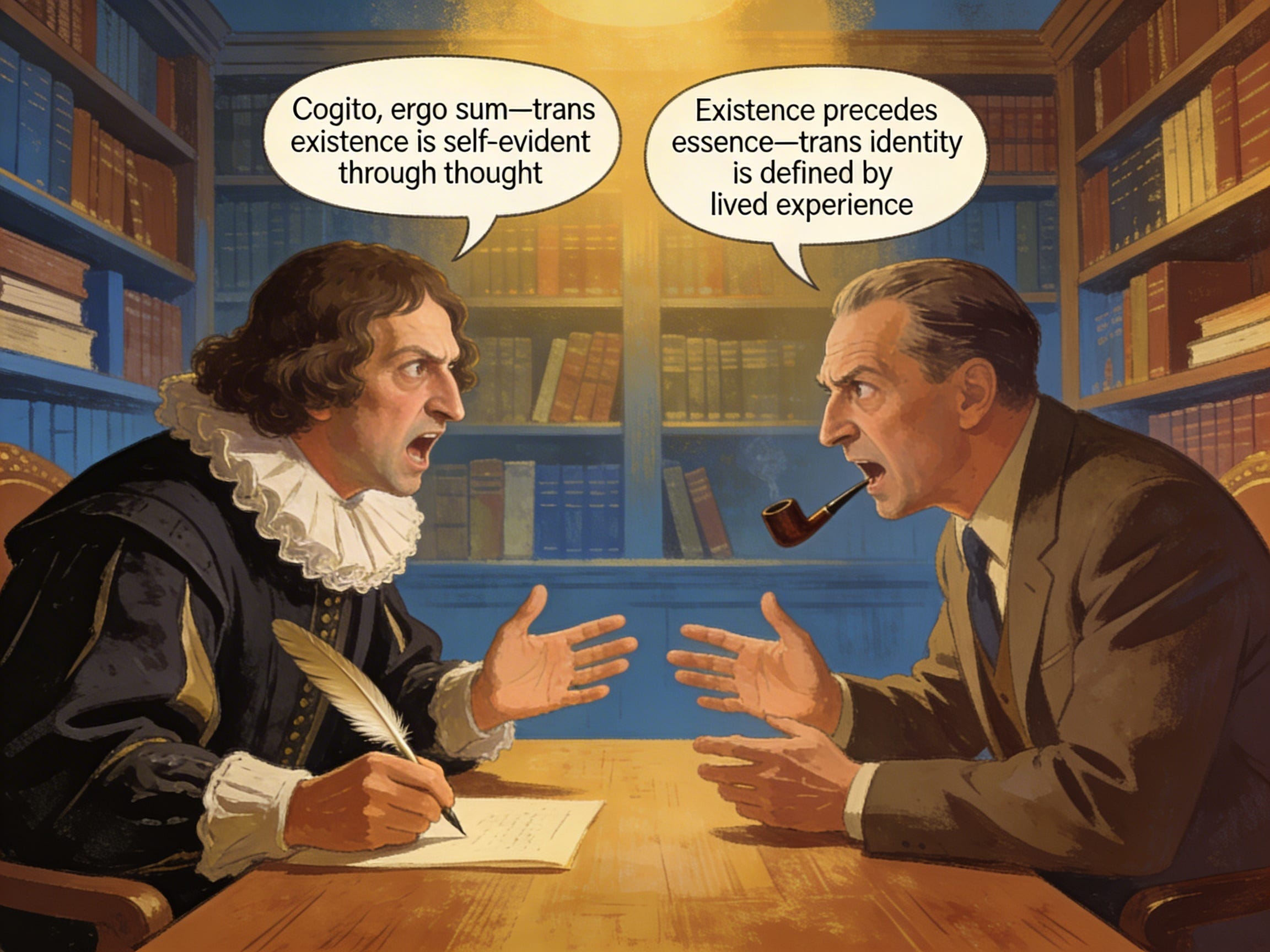
Welcome to Philosophy Sunday! Compass Star Wordsmith is nothing if not a vehicle for expression - all forms of it. I’ve been labeled many things and called many names. I leave it to others to define their experiences with me, but if most people are honest, I’ll come out ok in the end.
Trigger Warning: Thoughtful Discussion Ahead
This Sunday, CSW falls down a Fabbit Hole (fabulous rabbit hole) due to a Notes thread with a thoughtful ‘Stacker about Trans issues. Samantha Paige is more thoughtful and engaging than the typical Trans Warrior. Not saying that much, I get it. At the very least, she hasn’t labeled me or called me names, so there’s that.
In all seriousness, Samantha brings up some highly interesting and debatable points in our thread. I’ve taken the liberty (with consent) to use our thread as a basis for this weeks post. The engagement is worthy of debate. And here it is.
As always, Compass Star Wordsmith is forever looking for pirates with a cause and something to say. Bring it aboard and let’s get to sailin the seas of chaos together. Click blue to chip in some bounty. Like to validate. Share to share.

https://substack.com/@samantha705901
NOTES CAUSES THOUGHTFUL DIALOGUE
I know, hard to believe right? But the proof is in the the thread, and CSW is thankful for Samantha’s intelligent and thoughtful discourse.
Hamish McKenzie Chris Best Notes might work after all. Who knew?
Samantha Paige’s pivot in that recent thread was sharp: drag gender debates out of slogan territory and into ethics via the mind-body problem. If strict bio-essentialism rules—if chromosomes or bodies predetermine everything—then free will evaporates. No real choices, no genuine responsibility, no ethics worth the name. Why punish crime (or judge identity) if biology scripted it? The “I” that thinks, decides, grows—even from hard places like incarceration—demands agency beyond deterministic meat.
Samantha nods to Descartes implicitly: the cogito as starting point, the thinking self separate from body, capable of free yes/no. But the full thrust lands in Sartre territory, where existence precedes essence—no pre-given nature, just thrownness into the world and the burden of forging ourselves through radical freedom.
Let’s replay the exchange in blocks, then counter/reflect. This thread started innocently enough—a feminist affirmation of inclusive femininity—but it spiraled into a biology-vs-identity clash. Samantha elevated it further, weaving in epistemology, ethics, free will, and the mind-body problem. My replies held the line on biological facticity while granting personal happiness. What follows is a point-counterpoint breakdown: Samantha’s points (and the original poster’s) block-quoted for clarity, followed by my counters and reflections. It’s not about winning arguments; it’s about mapping the cultural terrain where these ideas collide.
The Opening Salvo: Inclusive Femininity Without Restraint
Kim Beckett: As a true feminist I embrace ALL expressions of femininity. I will not be restrained by gender norms or restrain others in their expression. All are welcome and valid. I reject any attempts to constrain any person based on their sex, identity or expression.
Samantha Paige: Thank you for posting this.
ric leczel: really? no other concerns? just a single cause and effect argument? or are there much deeper issues at play? remember the “Roid Rage” back in the day when men - some WWE stars - killed bc of the drugs they were taking? maybe we need to consider all of the concerns, not just from a “phobia” street corner
Point (inclusion side): Full embrace—no constraints based on sex/identity. Femininity is expression, not biology. This is the heart of modern inclusive feminism: tear down the gates, let everyone in. It’s a reaction to rigid norms that have historically boxed people in, especially women, but now extended to all genders and expressions. Why gatekeep something as fluid as femininity? If someone feels it, lives it, embodies it—welcome aboard. Constraining based on birth sex feels like a relic of patriarchy, a way to police bodies and identities under the guise of tradition.
Counter and Reflection: Concerns aren’t just “phobia.” Biology has downstream effects (hormones, aggression parallels, etc.). Ignoring them isn’t progressive; it’s selective blindness. Look, I’m all for personal expression—wear what you want, love who you want, call yourself what feels right. But when we talk about “all expressions” in shared spaces, biology sneaks back in. The “Roid Rage” reference wasn’t random: exogenous hormones can alter behavior, strength, mood. We’ve seen it in sports, prisons, even domestic violence stats. If a biologically male person transitions and enters women’s spaces (sports, shelters, dating pools), those effects don’t vanish with a new identity. It’s not about hating trans people; it’s about acknowledging material realities that impact safety, fairness, and consent.
This sets the stage for the deeper clash: is femininity a costume anyone can don, or does it intersect with bodily facticity? Kim’s post radiates good vibes, but it glosses over friction points. Samantha’s endorsement signals agreement, but my pushback questions the blind spots. Culture wars thrive here because one side sees liberation in boundless inclusion, while the other sees chaos in ignoring boundaries. As a Gen-X contrarian, I lean toward mapping both—freedom is great, but unmoored from reality, it risks harm.
The Identity Analogy: Apples, Oranges, and Fluid Categories
Samantha Paige: I am no more a man than a straight one is gay or a gay one is straight. Apples and oranges.
ric leczel: i’m not questioning your manhood at all. biology is biology. Chromosomes make the man, not your choice. but you do you and i hope you are happy. imposing paradoxical meanings on words is textbook 1984, so you call yourself whatever you would like to. it is interesting however, that the LGBs are splitting the rainbow alphabet in two. i mean, lots of biological female lesbians are not comfortable with biologically male lesbians something about a penis, I think
Point: Identity isn’t reducible to biology; analogies show categories are fluid/subjective. Samantha’s apples-and-oranges line is clever—it decouples gender from sex, much like sexual orientation isn’t a binary flip. A straight man isn’t “more straight” than a gay one; they’re just different fruits. This echoes queer theory: identities are performative, socially constructed, not etched in DNA. Why essentialize gender when we don’t for other traits? It’s a plea for subjectivity—let people define their own categories without bio-gatekeeping.
Counter and Reflection: Biology isn’t choice-denying destiny, but it sets parameters. Redefining terms risks Orwellian slippage. And material realities (bodies in intimate spaces) create friction—not hate, but coherence in orientation. Here’s where the rubber meets the road: sure, call yourself what you want—that’s your freedom. But when that redefinition spills into shared language and spaces, it affects others. “Lesbian” historically means female same-sex attraction; expanding it to include male-bodied people muddies the waters. It’s not abstract; it’s about bodies in bedrooms, locker rooms, prisons. The LGB split (e.g., groups like LGB Alliance) isn’t random bigotry—it’s lesbians saying, “Our orientation is tied to sex, not just gender identity.” Penises in lesbian spaces? That’s a hard no for many, rooted in facticity, not phobia.
This exchange highlights a key tension in contemporary gender discourse: subjective experience vs. objective biology. Samantha’s analogy prioritizes the former, which feels empowering individually but disruptive collectively. I’m not denying her identity; I’m saying biology provides the map we all navigate. Ignoring it for ideological purity feels like 1984’s Newspeak—redefining words to control thought. Culture’s alphabet soup is fracturing because these paradoxes aren’t sustainable. As someone who’s seen life’s hard edges (incarceration included), I value authenticity, but it has to square with reality.
The Philosophical Deep Dive: Mind-Body, Free Will, and Bio-Essentialism
Samantha Paige: My degrees, for what they’re worth, are in epistemology and in ethics. The study of how we know what we know and the study of what’s good for us. If put simply, moral superiority. Let’s switch gears for a second, and look at the mind body problem “ethically.”
For ethics to exist, we need free will. God gave it to us any way, right? [Monotheism itself is set up on a binary, but I digress]. If one does not have free will, well, it’s “unethical” to punish someone for doing something they couldn’t do otherwise. That “bite of the apple,” in other words. Bio essentialism, at full slope, essentially, erodes free will. We (the I’s that think from within our meat suits) make choices, right? Decisions? Subjectively experienced “yeses and noes?” Don’t we? You were incarcerated. Why? I don’t mean the facts, I mean the choice. The one you were punished for, I assume. And grew from? Or, were you biologically predisposed? Binaries…, 🤷🏻♀️
Point (Samantha’s core): Bio-essentialism = determinism = no free will = ethics collapses. The thinking “I” transcends the meat suit. Choices define us ethically; biology can’t override that without undermining responsibility (crime, growth, identity).
This is pure existentialist fuel. Descartes gives the mind priority (cogito first, thinking substance), but Sartre radicalizes it: no God, no fixed essence. We exist first—blank slate of freedom—then define ourselves. “Man is condemned to be free.” Facticity (body, biology, past) is real, but consciousness (for-itself) is nothingness: always projecting beyond, choosing projects. Gender transition? An authentic existential project—transcending assigned facticity to forge essence through choice.
Sartrean applications to gender abound in modern thought: one isn’t born a woman (Beauvoir’s line, rooted in Sartre); one becomes one through projects. Trans subjectivity often framed as rejecting essentialism—existence (lived body/experience) precedes any fixed gendered essence. Bio-essentialism becomes the bad-faith move: hiding behind “nature” to deny freedom.
Samantha’s invocation of my incarceration is poignant—it personalizes the stakes. If biology predetermines actions, why punish? Why grow? It’s a direct hit on determinism: ethics requires agency. The “meat suit” metaphor captures the dualism—body as vessel, mind as captain. Monotheism’s binaries (good/evil, male/female) get a side-eye, implying they’re constructed too. Overall, it’s a sophisticated pivot: from surface-level inclusion to profound questions of what makes us human.
Counter and Reflection: Yet Sartre isn’t license to ignore facticity. He warns against bad faith in both directions: denying freedom (essentialist determinism) and denying facticity (pretending constraints don’t exist). Freedom is always situated—thrown into a world with bodies, others, limits. We choose in relation to facticity, not by erasing it.
So, let’s unpack this Sartrean lens more deeply, because Samantha channels it beautifully, but there’s room for nuance.
Radical Freedom Doesn’t Erase Biology: Chromosomes, hormones, reproductive systems are brute givens—the hardware of the meat suit. We pilot it with choices, yes—transcend, affirm, modify—but can’t will it into non-existence. Sartre’s waiter in bad faith plays the role too rigidly; the trans existentialist who insists “biology is irrelevant” risks a similar over-identification with transcendence, ignoring how facticity shapes shared reality. Medical transitions alter the body, but they don’t rewrite gametes or skeletal structure. That’s not denial of freedom; it’s acknowledgment of the terrain. Sartre would call ignoring it a flight from anguish—bad faith via fantasy.
Lesbian Discomfort and Situated Freedom: Not phobia—facticity-bound attraction. A female-attracted woman’s project includes bodily coherence. Forcing inclusion (e.g., redefining “lesbian” to encompass penises) imposes one freedom on another’s, creating bad faith for all: the included denies others’ situated choices; the excluders might deny broader freedom. Sartre emphasizes the “look” of the Other—we’re always in relation. Gender debates often pit individual projects against collective ones (e.g., women’s sports). Whose freedom wins? Ethics demands balancing, not one-sided transcendence.
Ethics, Responsibility, and Ripples: Samantha’s right—free will underpins punishment/growth. But Sartre’s freedom is absolute and anguishing: total responsibility for choices, including consequences in a shared world. If we invent meanings (gender as fully chosen), we own the ripple effects—sports fairness, prison safety, dating boundaries. Dismissing those as “phobia” dodges responsibility. My incarceration? Choices, yes—bad ones, owned and grown from. But biology played a role (testosterone-fueled impulsivity? Maybe). It’s not either/or; facticity and freedom intertwine. Punish because choices matter, but understand biology as the context.
Binaries and the Human Condition: Monotheism/binary digression aside, biology presents sexual dimorphism as a deep facticity for most humans. Not destiny, but a constraint freedom navigates. Sartre didn’t apply his philosophy to gender fluidity (he lived pre-trans visibility boom), but his framework doesn’t demand suspending material distinctions—it demands authentic projects within them. Beauvoir adapted it to feminism, arguing women are “made” by society, but she didn’t erase sex; she critiqued its oppression. Today’s discourse sometimes flips that—erasing sex to liberate gender. Is that progress or overreach?
In short: Samantha channels Sartre beautifully—existence precedes essence means we forge gender through freedom, not chromosomes. But Sartrean authenticity requires facing facticity squarely, not wishing it away. Celebrate self-creation; name biological realities as the terrain we traverse. When spaces/sports/intimacy hinge on sexed bodies, “apples and oranges” feels like evasion.
Expanding on this, consider the broader cultural swim. We’re in an era where mind-body dualism is resurgent via tech (VR selves, AI consciousness) and identity politics. Descartes’ cogito promised certainty in thought alone, but Sartre stripped the illusions: no God, no essence, just freedom’s burden. Trans narratives often embody this—rejecting the “assigned” body as inauthentic, forging a new essence. It’s inspiring, but when it collides with others’ facticities (e.g., female athletes losing to transitioned males), ethics gets messy. Harm isn’t intended, but it’s real. Sartre would say: own it, choose differently, or accept the anguish.
My own lens? Gen-X skepticism: I’ve seen ideologies promise utopia while ignoring human hardware. Biology isn’t a prison; it’s the canvas. Free will paints on it, but can’t swap it for a blank one without consequences. Incarceration taught me that—choices echo in bodies and communities.
Wrapping the Threads: Holding Tension Without Resolution
I’m not gatekeeping happiness or expression. Do you, authentically. But culture swims in tension: radical freedom meets unyielding bodies. Can we hold both—Sartrean project and biological parameters—without contradiction? Or must we pick lanes? Samantha’s thread forces the question: is the mind-body problem solvable, or just navigable?
Sartre or Descartes fork: secure foundations (mind/soul first) vs. no-net building. Samantha leans existentialist. The thread shows why it matters—not just for gender, but for how we ethicize everything from crime to climate (biology vs. choice again?).
Thoughts? Fire away—no phobes, no saints. Just mapping the swim. Scroll down to click on blue to support the cause. Scroll further down to find musical treasure.
Ric
Looks to be an interesting conversation, though I'm reminded of a quip from Nietzsche about philosophers in general -- "They muddy the waters to make them seem deep." Job security, right from the time of Deep Thought.
But would you happen to have a link or two to it? "Samantha" -- Sam? -- has blocked me so I'm not able to see or read any of his posts. But clearly he's a bit of a jam tart, a gutless wonder, probably as dishonest as the day is long. Probably goes with the territory of claiming that it's possible to change sex, although he may not have done so explicitly himself. But I see his Substack bio has him claiming to be a "transfem" so moot as to what craziness is lurking in his head. Don't think it is particularly wise to be pandering to the delusional.
Though I kind of think many people go off the rails, if not into crazy town, over the issue of essentialism. Moot exactly where and how that occurs, but I remember a Wikipedia snippet that seems relevant:
Wikipedia: Essentialism has been controversial from its beginning.
https://en.wikipedia.org/wiki/Essentialism
Also moot exactly where the problem there lays, and I can't say that I've fully gotten to the bottom of it. But I kinda think it has to do with the fact that categories are abstractions; they're not real things in themselves. And to think they are is a category error, a case of reification, of "a fallacy of ambiguity, when an abstraction (abstract belief or hypothetical construct) is treated as if it were a concrete real event or physical entity."
https://en.wikipedia.org/wiki/Reification_(fallacy)
For example, one might ask, what is the "essence" of "teenager"? But, again, "teenager" is just the name for a category, it's not a real thing in itself with weight and volume. We don't become 10 pounds heavier when we have our 13th birthday and lose the same weight on our 20th birthday. The word is simply a label for those in an certain age range -- no "essence" that appears and disappears on different birthdays. That the word is an abstraction tends to make people forget the difference between the map and the territory -- a concept that that Reification article goes into some depth on.
SAME thing with "male" and "female". They're labels, names for categories of those possessing certain reproductive abilities, notably oogenesis in females and spermatogenesis in males. Every last female and male on the planet -- in literally millions of species and in trillions of organisms over the last several billion years or so -- has exhibited either of those two processes. That's what makes the sexes into "natural kinds". Do note what an unbiased source [Google/Oxford-Languages] defines the sexes as:
"sex: either of the two main categories (male and female) into which humans and most other living things are divided on the basis of their reproductive functions"
The sexes are also just names for categories and members of them; there's no "essence" to them beyond the criteria for category membership. And for mammals, including the human one, the criteria are, to a first approximation, having ovaries for females and testicles for males.
So while "Samantha" (Sam?) may well "think" he's a female -- batshit crazy if he does, but since he apparently has a couple of kids of his own who call him "Dad", he must have had some testicles at some point which is what qualifies him as a male. Though if he's cut them off then, technically speaking at least, he no longer qualifies as such; he's simply a sexless eunuch.
Daily Whatever: "She [Samantha] talked about coming out to her kids and how they still call her Dad, and how that’s okay."
https://www.thedailywhatevershow.com/p/the-daily-whatever-show-jan-7-with
"she" and "her". What a great steaming pile of horsecrap -- "Who are you going to believe? Me or your lying eyes?" I rather doubt his passport will say "female". At least if Trump has anything to say about it, and it looks like the Supreme Court has given its blessings on that policy. Membership in the sex categories has any number of consequences -- medical and various governmental regulations for several -- and it is rather important that our "identity documents" reflect those quite brute facts.
For example, you might be "amused" by this recent case:
NYTimes: The Transgender Cancer Patient and What [HE] Heard on Tape ... [HE] had been asked to take a pregnancy test, a routine preoperative step for female patients.
https://www.nytimes.com/2025/12/01/nyregion/transgender-patient-records-during-cancer-surgery.html?unlocked_article_code=1.KlA.z1-l.j29OEk86UNGN&smid=url-share
The guy should have been charged double for the test, if not for outright fraud.
And more than a few other cases of the same type, this one about a pregnant transman (i.e., an adult human female, a woman):
QUOTE; The Federalist: Baby Dies Because Doctors Were Told His Pregnant Mother Was A Man ....
The New England Journal of Medicine recently reported that a man [!!] gave birth to a stillborn baby. The story is especially tragic because the hospital’s medical staff did not treat the pregnant man [!!] in a timely fashion. Had they done so, the baby might have lived.
Now that you’ve read that opening paragraph at least a couple times to decide if you misunderstood it, let me explain a bit more. The unidentified birth giver began life biologically as a female but had sex-reassignment surgery to become a “man.” It seems, then, that the “former” female retained a viable ovum, and when she engaged in a sex act with a man, that ovum was fertilized. UNQUOTE
https://thefederalist.com/2019/05/23/baby-died-doctors-told-mother-man/
And that's only the tip of the Titanic-sinking iceberg of what happens when we give any credence, even the time of day, to the batshit crazy idea that we can change sex.