
Let's Not Talk
Are we still "Not talking about Trump"? No more normalizing? But alas, he's on everyone's mind, and still dividing friends, family, and fellowship. Let's change.

The beacon here is stark: contempt for one man has metastasized into a litmus test that exiles half the country—and half the family—from the circle of the acceptable.
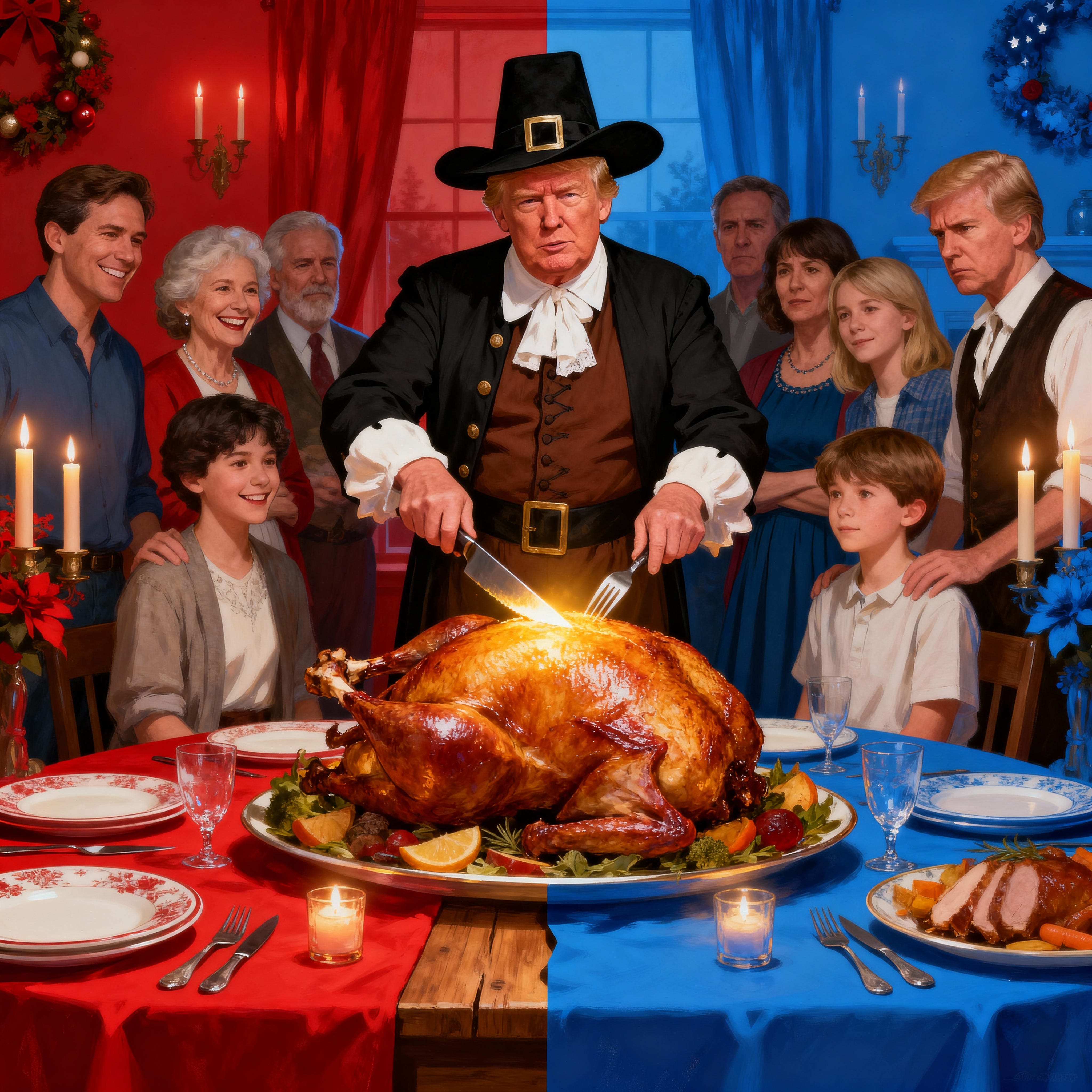
On Thanksgiving Day 2016, Trump was the President-Elect and the country was on fire, set by peaceful protestors. But that was merely the calm before the storm. Regardless if you loved him or hated him, it was he that had captured the collective chimera and set us on the path to here and now. Where are we now?
The families that have been bifurcated due to this cultural-political hurricane include my own even to this day. I wonder if in the 1850s families divided were like this? The gulf has not shrunk an inch and seems wider than ever before. Can Thanksgiving Dinner bridge the gap to bring us together like we’ve never known?
A decade later, could anyone imagine exactly where we’d end up? Compass Star Wordsmith did and has been charting the uncharted waters in the wake of this cultural-political tsunami to lay down some navigational beacons. The fracture runs deeper than policy or personality; it’s a moral contagion. Click a button below to jump on board.
Trump Voter versus Trump Supporter
Not every hand that pulled the lever for Trump in 2016, 2020, or 2024 belongs to a red-hatted zealot. The moral contagion that exiles “anyone in the orbit” rarely asks the question that would save a friendship, a job, or a family dinner: Are you a voter, or a supporter? The difference is not academic; it is the gap between a vote in private in person or a Trump flag flown proudly and defiantly. Both voted for him.
The voter is transactional. He is the welder in Erie who voted Obama twice, then Trump twice, because the mill reopened and the gas bill stopped bleeding. She is the nurse in Macomb County who backed Romney, then Clinton, then Trump—each time betting on the candidate who promised the hospital would stay open. These are not converts; they are diagnosticians.
They see a country in triage and choose the treatment that looks least like placebo. They own zero MAGA gear. They have never stood in a rally line. Their bumper sticker, if it exists, is a faded “I Voted” from 2020. When Trump wins, they exhale and check the price of eggs. When he loses, they mutter “next time” and flip to the weather.
The supporter is fervent. She owns the hat, the flag, the signed copy of Crippled America. He has flown to three rallies, tailgated with strangers, and live-tweeted every indictment hearing. The supporter does not wait for better policy; he waits for vindication. Trump is not a means—he is the message. The voter wants the plant reopened; the supporter wants the plant reopened and the foreman to say “thank you, sir” on national television. The voter will abandon ship if the captain starts drilling holes. The supporter bails water with a teaspoon and calls it loyalty.
This spectrum is real, measurable, and ignored at the shunning table. Exit polls from 2024 show 28 percent of Trump voters had backed Biden in 2020—classic switchers, not lifers. In Pennsylvania, 41 percent of Trump voters said they would not support him in a future primary against a different Republican. They are not ride-or-die; they are ride-until-the-wheels-fall-off-and-then-walk. Yet the roommate, the HR memo, the TikTok tribunal treats every orbit-dweller the same: radioactive.
The cruelty is in the conflation. The voter becomes collateral damage in a war against the supporter. The boyfriend—whose parents merely attended the Phoenix vigil is not waving a Trump flag—he is a 25-year-old American that voted based on his particular circumstances. But the boundary is drawn anyway, because nuance is exhausting and purity is effortless.
Compass Star Wordsmith offers a new beacon: Ask the question. Before the block, before the unfollow, before the empty chair at Thanksgiving, ask: Did you vote to fix something, or to follow someone? The answer will not reconcile the country, but it might save the roommate.

Hate Trump personally and you’re compelled to hate anyone in his orbit—guilty by association, no appeal. Jimmy Kimmel’s wife bans Trump-voting relatives from the holiday table. Psychologists publish open letters urging patients to sever ties with parents who cast the “wrong” ballot. My own daughter’s sixth-grade best friend refuses to meet her boyfriend whose parents attended a Turning Point USA vigil for Charlie Kirk after his assassination and who admits he voted Trump; the friend even asked that The Daughter’s location sharing be disabled so she doesn’t have to watch her visits in real time. These are 25 year old people.
The beacon here is stark: contempt for one man has metastasized into a litmus test that exiles half the country—and half the family—from the circle of the acceptable. If public praise of Trump is disallowed, is criticizing him equally forbidden? If not, why? Is the next answer then to shun nearly 80 million voters?
The Mirror Fracture: When the Divide Eats Its Own
The antibodies are not aimed at ideas; they are aimed at people. And the people are not abstractions—they are the cousin who posts a MAGA hat selfie, the neighbor whose pickup sports a faded “Trump 2020: No More Bullshit” sticker now peeling at the edges. Each is a vector. Each must be quarantined.
But in 2025, the same contagion is eating the Democratic Party alive. The outside—Trump’s Congress, a 42-day shutdown, and electoral humiliation—has turned inward. Schumer and Fetterman now face the same exile once reserved for red hats. The fact they voted opposite of each other and are now equally hated by the new base. They both disagree with Trump, but both are now targeted.
Eight Senate Democrats, including Fetterman, broke ranks in October 2025 to end the longest government shutdown in history. The deal gave no ACA subsidies and punted the fight to January. Schumer voted no, but the left erupted. Rep. Ro Khanna tweeted: “Senator Schumer is no longer effective and should be replaced.” #FireSchumer trended. Progressives called it betrayal of furloughed workers and SNAP families. A September Pew poll showed Schumer’s approval underwater—even among Democrats.
Fetterman, once a progressive hero, became the villain. He had called the shutdown “wrong” on Fox and X, prioritizing military pay and federal workers. His reward: 62% disapproval from Democrats in a November Quinnipiac poll, while Republicans approved 54%. Rep. Brendan Boyle labeled him “Trump’s favorite Democrat.” Protesters hit his Pittsburgh office over Gaza and border votes. When he fell down last weekend, MAGA sent well-wishes; Democrats sent death-wishes.
This rupture proves the rule: the outside wins when the inside implodes. Compass Star Wordsmith’s beacon is simple—recognize the mirror. If Democrats exile their own over a vote, they’re no different from the roommate silencing a friendship over a parent’s vigil. Mercy, not quarantine, is the only way forward
Consider the Kimmel household, 2022. Molly McNearney, Kimmel’s wife and co-producer, told the world on Instagram that Trump supporters were no longer welcome at Thanksgiving. “I don’t want to break bread with people who think it’s okay to separate children from their parents at the border,” she wrote, as if every red-hat owner personally welded the cages.
The comments erupted in applause—thousands of blue-check affirmations that family is conditional, love is revocable, and pumpkin pie is a privilege, not a right. Kimmel himself doubled down on air: “If you voted for him, you’re not invited. Simple as that.” The studio audience roared. The message was clear: politics is not a difference of opinion; it is a difference of species.
The therapists had ploughed the ground and planted the seeds. In the summer of 2017, Psychology Today published “How Do We Parent in the Trump Era?”—a piece that hit like a quiet earthquake. The author urged parents to model ethics in real time, warning that kids absorb the president’s crass, crude, and demeaning style the way they absorb everything else. The takeaway wasn’t spelled out in bold, but it was there between the lines: if a leader’s behavior is toxic, shielding your child might mean shielding them from the people who cheer it.
The comments lit up with confessions. One parent wrote: “Explaining this to my 10-year-old feels like betraying half my family.” Another admitted to muting group chats after a MAGA selfie. The piece didn’t say cut them off—but it didn’t have to. The seed was planted: political difference isn’t just disagreement; it’s moral injury. Protect the nervous system. Draw the line.
Years later, that line became a wall. The article didn’t start the fire—but it handed out the matches.
Dating apps became minefields. Hinge rolled out a “political views” filter in 2022; by 2024 it was the default sort. Swipe left on “moderate,” “conservative,” or “other.” Bumble added a badge: “No Trumpers.” The badge doubled as a rose—you could send it to signal virtue, and the algorithm boosted your profile to similarly badged users. A 2025 study from Pew found that 63 percent of urban women under 35 would not date across the Trump line, up from 41 percent in 2016. The men adjusted: profiles bloomed with disclaimers—“Voted Biden twice, still think Trump is a threat to democracy”—like Soviet-era loyalty oaths. One man in Brooklyn listed his height as “5’11\” but 6’2\” in ambition to dismantle the patriarchy.”
Friendships atrophied. In 2023, the New York Times Weddings section ran a vow-renewal announcement with a twist: the couple credited their marriage surviving “the Trump years” because they had “pruned” three college friends who “revealed themselves” in 2016. The pruned friends were not named, but the couple included a photo of their new dinner table—seating for six, down from ten. The caption: “Smaller circle, bigger love.”
Charlie Kirk was assassinated on September 10, 2025, while speaking to a crowd of approximately 3,000 at Utah Valley University in Orem, Utah, during Turning Point USA’s “American Comeback Tour.” He was 31 years old, shot once in the neck by a sniper positioned on a rooftop. He died at Timpanogos Regional Hospital shortly after. Vigils followed nationwide, including one at Turning Point USA headquarters in Phoenix where supporters left flowers, candles, and American flags.
President Trump announced he would attend Kirk’s funeral in Arizona and award him the Presidential Medal of Freedom posthumously. Within hours, the hashtag #KirkCult trended on TikTok, with one video—stitching footage of mourners singing “How Great Thou Art”—captioned “This is what fascism looks like when it prays,” garnering 11 million views.
At UVU, protesters attempted to replace a student-led memorial for Kirk with a “unity” display, citing his past statements on abortion, guns, and election integrity as “hate speech.” Corporate HR departments in the Southwest quietly updated social-media policies: employees photographed at any Kirk vigil would be flagged for “values alignment review.”
My daughter’s roommate—25, same as her—learned of the connection during an honest conversation one evening in their shared apartment. The boyfriend had never been in the apartment or spoken directly to the roommate. His parents had attended the Phoenix vigil for Charlie Kirk, and he had simply confirmed it when my daughter asked him about it. He does not wear red hats or speak loudly about politics.
The roommate listened quietly, then said she needed to set a boundary: the link, however indirect, made her too uncomfortable to meet him. She asked, with respect, if my daughter would disable location sharing so she wouldn’t see the visits in real time. My daughter understood the depth of her friend’s feelings and quietly turned it off. Their friendship, once effortless, now moves in careful, unspoken steps around the apartment.
This is the new etiquette: silence as shunning, read receipts as excommunication. The tools are mundane—block, mute, restrict, unfollow—but the effect is medieval. Brands joined the ritual.
The irony is thick: the side that chants “love trumps hate” has built the most sophisticated hate machine in modern memory. It does not need camps or gulags; it has algorithms, HR departments, and the soft totalitarianism of social consequence. The punishment is not prison—it is loneliness. The crime is not violence—it is voting.
Compass Star Wordsmith has watched this unfold since 2016, logging the incremental surrenders: the friend who stopped inviting the Trump-voting couple to game night, the cousin unfollowed after a single retweet, the coworker who now eats lunch alone because she liked a JD Vance post. Each surrender seemed small, rational, even moral in the moment. Aggregated, they form a map of exile.
The beacons are simple:
1. Contempt is contagious; quarantine it before it quarantines you.
2. People are not their vote; relationships are not referenda.
3. Silence is complicity only when the cost of speech is death; in America 2025, the cost is brunch.
4. The Overton Window has bars; do not volunteer to be the warden.
We are not post-partisan; we are pre-civil. The fire next time will not be lit by Molotovs but by muted group chats, canceled invitations, and children taught to fear their grandparents’ politics. The republic can survive policy disagreement. It cannot survive half its families treating the other half as moral lepers.
Thanksgiving 2025 approaches. Some tables will have empty chairs and carefully worded toasts. Others will have full bellies and fuller hearts, having decided that cranberry sauce is not a loyalty oath. The choice is ours, one plate at a time.
Compass Star Wordsmith signs off with a final coordinate: love is not the absence of standards; it is the presence of mercy. Plot your course accordingly.
Love one another,
Ric
Great post. Enjoyed the analysis. 🏆🏆🏆
It's crazy to hear and, thankfully, I don't have that sort of crazy in my orbit.